

Fox's Gift Shop II Wide Sponsorship Banner Il Bacco Sponsorship Banner
Contact Coordinator of Faith Formation
Ms. Rose Ruesing
prep@standrewavellinorcchurch.org

 Confirmation Photos 2023

First Communion Photos 2023

Religious Education Registration Form

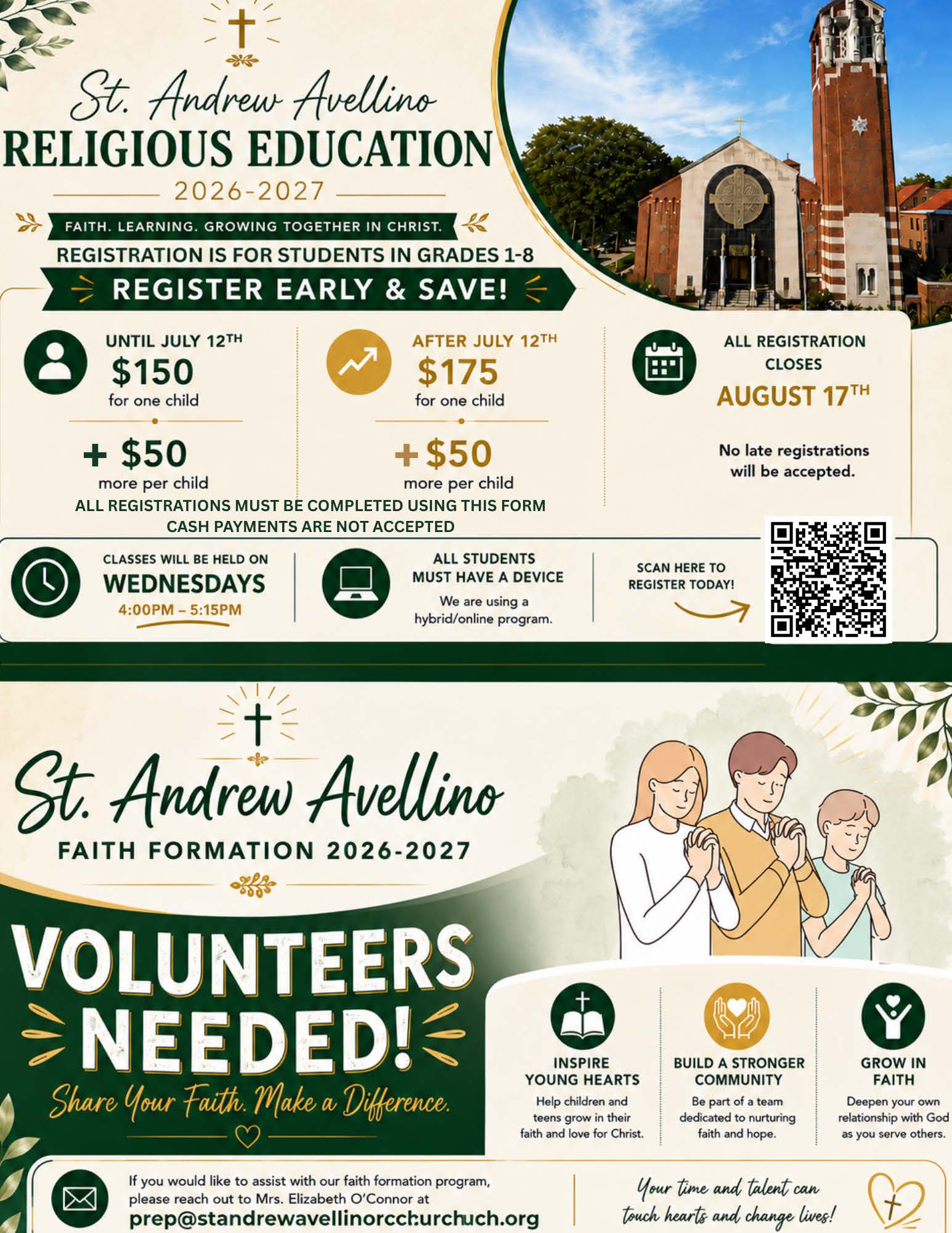
St. Andrew Avellino Parish Religious Education Program (PREP) is committed to growing children in faith through catechesis with an emphasis on the Spiritual and Corporeal Works of Mercy.

Religious Education is a life-long learning process. It is not just “Communion Preparation” or “Confirmation Preparation.” The middle years are just as important and the first two and last two.

Family Obligations

Parents are the primary catechists. Your words and deeds help a child understand how to live Christ-like. There are four ways parents can aid in their child’s religious instruction:

  1. ATTEND SUNDAY MASS and partake in the sacrament of Reconciliation regularly.
  2. MODEL faith through prayer.
  3. ENCOURAGE your child to take an active role in their own faith life.
  4. PARTICIPATE in service to others.
  5. ENROLL your child for consecutive years of faith formation.
Registration Fees

Registration fee: $150 for one child, $200 for two or more children

Sacrament Donation: $100 (made during the second year of sacrament preparation)

NO CHILD will be denied education or the sacrament due to financial hardship.

For additional information please contact:

Ms. Rose Ruesing

Coordinator of Faith Formation

prep@standrewavellinorcchurch.org

Frequently Asked Questions about Religious Education

When should my child begin Religious Education?

Children should begin in first grade and continue through eighth grade for confirmation. We understand that life happens and are prepared to work with each family.

When do classes meet?

Classes meet on each Monday at 5:00 p.m. for all grades. Public school schedule is taken into consideration when creating the schedule for the year. We do not meet during the holiday breaks.

What do I need to register?

Please register online. Forms are also available in the Parish Office. First time registrants will need to submit their child’s Baptismal Certificate.

What if we are transferring in from another program?

Please register online and indicate which parish you last attended. We will contact them for a letter of transfer.

What if my child begins religious education classes in second grade or later?

If you child is in second grade, they will be placed in Level 1 for their first year and Level 2 for their second year. After they receive First Communion, they will be placed in Level 4 so they can continue classes with their age group leading up to confirmation.
If your child is in grade three to six and attending religious education for the first time, they will participate in a Bridge class for one year before being placed in the level with their age group. Bridge classes can also be completed the summer before the school year.
If your child is in grade seven and above, they will be placed in a Bridge class for one year. Then, they will be placed in Level 7 Confirmation Prep 1 and make their confirmation after completing Level 8 Confirmation Prep 2

What if my child hasn’t attended religious education classes since receiving First Communion and is now in the seventh grade?

Your child will be treated like other Bridge students if they have missed more than one year of religious education classes. They will attend one year of Bridge and then will proceed with Level 7 Confirmation Prep 1 and then Level 8 Confirmation Prep 2. It will be a three-year process.

What if my child has not been baptized?

Those eight years old and older who were never Baptized can begin the RCIC classes. They will be placed with the Bridge Class to start before preparing for the sacraments. How they will proceed the second year will involve a discussion between the family, Coordinator of Religious Education, and the Pastor, as there are a couple of different paths at that point which depend on the age of the child.

 El Programa de Educación Religiosa de la Parroquia de St. Andrew Avellino (PREP) está comprometido con el crecimiento de los niños en la fe a través de la catequesis con énfasis en las Obras de Misericordia Espirituales y Corporales.

La educación religiosa es un proceso de aprendizaje de por vida. No es solo “Preparación para la Comunión” o “Preparación para la Confirmación”. Los años intermedios son igual de importantes y los dos primeros y los dos últimos.

Obligaciones familiares

Los padres son los catequistas principales. Sus palabras y hechos ayudan a un niño a comprender cómo vivir como Cristo. Hay cuatro formas en que los padres pueden ayudar en la instrucción religiosa de sus hijos:

  1. ASISTIR A LA MISA DEL DOMINGO y participar en el sacramento de la Reconciliación con regularidad.
  2. MODELO de fe a través de la oración.
  3. ANIME a su hijo a tomar un papel activo en su propia vida de fe.
  4. PARTICIPAR en el servicio a los demás.
  5. INSCRIBE a tu hijo en años consecutivos de formación en la fe.
Cuotas de inscripción

Cuota de inscripción: $ 150 para un niño, $ 200 para dos o más niños

Donación sacramental: $100 (realizado durante el segundo año de preparación sacramental)

A NINGÚN NIÑO se le negará la educación o el sacramento debido a dificultades financieras.

Para obtener información adicional, comuníquese con:

Sra. Rose Ruesing

Coordinadora de Formación en la Fe

prep@standrewavellinorcchurch.org

Preguntas frecuentes sobre educación religiosa

¿Cuándo debe mi hijo comenzar la educación religiosa?

Los niños deben comenzar en el primer grado y continuar hasta el octavo grado para la confirmación. Entendemos que la vida pasa y estamos preparados para trabajar con cada familia.

¿Cuándo se reúnen las clases?

Las clases se reúnen todos los lunes a las 5:00 p.m. para todos los grados. El horario de la escuela pública se tiene en cuenta al crear el horario para el año. No nos reunimos durante las vacaciones.

¿Qué necesito para registrarme?

Regístrese en línea. Los formularios también están disponibles en la Oficina Parroquial. Las personas que se registren por primera vez deberán presentar el certificado de bautismo de su hijo.

¿Qué sucede si nos estamos transfiriendo desde otro programa?

Regístrese en línea e indique a qué parroquia asistió por última vez. Nos pondremos en contacto con ellos para una carta de transferencia.

¿Qué sucede si mi hijo comienza las clases de educación religiosa en segundo grado o más tarde?

Si su hijo está en segundo grado, será colocado en el Nivel 1 para su primer año y en el Nivel 2 para su segundo año. Después de recibir la Primera Comunión, serán colocados en el Nivel 4 para que puedan continuar las clases con su grupo de edad hasta la confirmación.
Si su hijo está en los grados tercero a sexto y asiste a educación religiosa por primera vez, participará en una clase Bridge durante un año antes de ser colocado en el nivel de su grupo de edad. Las clases puente también se pueden completar el verano antes del año escolar.
Si su hijo está en el grado siete o más, será colocado en una clase Bridge por un año. Luego, serán colocados en el nivel 7 de preparación de confirmación 1 y harán su confirmación después de completar el nivel 8 de preparación de confirmación 2

¿Qué sucede si mi hijo no ha asistido a clases de educación religiosa desde que recibió la Primera Comunión y ahora está en séptimo grado?

Su hijo será tratado como otros estudiantes de Bridge si ha perdido más de un año de clases de educación religiosa. Asistirán a un año de Bridge y luego procederán con el Nivel 7 de Preparación para la Confirmación 1 y luego con el Nivel 8 de Preparación para la Confirmación 2. Será un proceso de tres años.

¿Qué pasa si mi hijo no ha sido bautizado?

Los mayores de ocho años que nunca fueron bautizados pueden comenzar las clases de RCIC. Serán colocados con la clase Bridge para comenzar antes de prepararse para los sacramentos. Cómo procederán el segundo año implicará una discusión entre la familia, el Coordinador de Educación Religiosa y el Pastor, ya que hay un par de caminos diferentes en ese punto que dependen de la edad del niño.

Throughout the year the parish offers several different opportunities for our parishioners to grow more and learn more about their faith. In the past we have had a Lenten Speaker Series and an Advent Day of Prayer. Last year we held a three-day Parish Mission during Lent. We continue to use the Bishop Barron series on Catholicism in both English and Spanish as well as beginning his series on "Pivotal Players". Please see our bulletin for upcoming events in the future. A lo largo del año, la parroquia ofrece varias oportunidades diferentes para que nuestros feligreses crezcan más y aprendan más sobre su fe. En el pasado hemos tenido una Serie de Oradores de Cuaresma y un Día de Oración de Adviento. El año pasado llevamos a cabo una Misión Parroquial de tres días durante la Cuaresma. Continuamos usando la serie del obispo Barron sobre el catolicismo tanto en inglés como en español, así como comenzando su serie sobre "Jugadores fundamentales". Consulte nuestro boletín para conocer los próximos eventos en el futuro.
Becoming Catholic – An Overview of the RCIA

Faithful to the commissioning of Jesus Christ to His first Apostles to “go out and make disciples of all nations…” (Matthew 28:19), the Catholic Church welcomes new adult members through a faith formation process called the Rite of Christian Initiation of Adults, or R.C.I.A. The RCIA is a journey of faith through which new adult members come to know Jesus Christ and the faith, tradition, and rituals which He has passed down to us. This journey of faith is a gradual process of conversion, through which a person’s first stirring of faith and God’s presence in one’s life is transformed into a life lived in true faith, love, and justice, lived in communion with other Catholics throughout the world and most fully realized in the Holy Sacrifice of the Mass.

The RCIA is marked by several ceremonial stages and periods of learning through which a person becomes a full member of the Catholic Church. The timing of each stage varies according to the spiritual readiness of the individual person, so a person may take as much time as he or she needs in the initiation process before entering into full initiation in the Church through the sacraments of Baptism, Confirmation, and Holy Eucharist.

Who can begin the RCIA journey?

Anyone who is open to strengthening or re-discovering their faith and desires to know more deeply about God and His Church is open to undergoing the RCIA process. Typically, the RCIA model applies to the following individuals:

  • Unbaptized: Those individuals 16 years of age and older who have never been baptized, and who sincerely seek to convert their lives over to God are known as “catechumens.”
  • Baptized in another Christian Church: Those who have been baptized in another Christian denomination and who desire to enter into full communion with the Catholic Church are called “candidates.”
  • Baptized but uncatechized Catholic Adults: Those who have already been baptized in the Catholic Church, but who wish to complete their initiation in the Catholic Church, are prepared to celebrate the sacraments of Reconciliation, Confirmation, and Holy Eucharist. These individuals are also considered “candidates.”
The 5 Stages of the RCIA:
  1. Period of Pre-catechumenate or Inquiry – this stage marks a time when the individual first expresses interest in becoming Catholic and becomes acquainted with the Catholic Church and some of its teachings with the help of the parish community. The end of this stage is marked by the Rite of Acceptance, during which the inquirer publicly expresses their desire to enter into full communion with the Catholic Church and the parish community affirms their desire to follow God’s call.
  2. Period of Catechumenate – this stage marks an extended period which can last a year or more, and is a time of formation and deeper reflection upon the Sacred Scripture and Tradition of the Catholic Church and how they are lived out in one’s daily life. The end of this stage is marked by the Rite of Election, during which the names of the catechumens are enrolled in the diocese and the catechumens publicly request Baptism and declare their desire to make a deeper commitment to Christ and His Church in the presence of the Bishop.
  3. Period of Purification and Enlightenment – this stage coincides with the liturgical season of Lent and is a time of intense spiritual preparation before receiving the sacraments of initiation. This period is marked by various purification rituals called Scrutinies, which take place during the 3rd, 4th, and 5th weeks of Lent, during which the Elect are invited to reflect more deeply upon their own sinfulness and their desire for salvation in communion with the rest of the Church community.
  4. Reception of the Sacraments of the Initiation – having been thoroughly prepared and immersed in the life of the Catholic faith, the individual receives the sacraments of initiation at the Easter Vigil.
  5. Period of Mystagogy – this is a lifelong period for every Catholic during which the individual, especially the newly initiated Catholic, discovers how one is called to live out their Christian vocation through participation in the liturgy, various acts of charity, and apostolic service in the Church.


For those interested in beginning the RCIA journey, please contact Rev. Gregory M.V. McIlhenney, at the Rectory.

 Convertirse en católico: una descripción general del RICA

Fiel a la comisión de Jesucristo a sus primeros Apóstoles de “salir y hacer discípulos a todas las naciones…” (Mateo 28:19), la Iglesia Católica da la bienvenida a nuevos miembros adultos a través de un proceso de formación en la fe llamado Rito de Iniciación Cristiana de Adultos. , o R.C.I.A. El RICA es un viaje de fe a través del cual los nuevos miembros adultos llegan a conocer a Jesucristo y la fe, la tradición y los rituales que Él nos ha transmitido. Este camino de fe es un proceso gradual de conversión, a través del cual el primer impulso de fe de una persona y la presencia de Dios en su vida se transforma en una vida vivida en verdadera fe, amor y justicia, vivida en comunión con otros católicos en todo el mundo y plenamente realizada en el Santo Sacrificio de la Misa.

El RICA está marcado por varias etapas ceremoniales y períodos de aprendizaje a través de los cuales una persona se convierte en miembro de pleno derecho de la Iglesia Católica. El tiempo de cada etapa varía de acuerdo con la preparación espiritual de la persona individual, por lo que una persona puede tomar todo el tiempo que necesite en el proceso de iniciación antes de entrar en la iniciación completa en la Iglesia a través de los sacramentos del Bautismo, Confirmación y Santa Eucaristía.

¿Quién puede comenzar el viaje de RICA?

Cualquiera que esté abierto a fortalecer o redescubrir su fe y deseos de conocer más profundamente a Dios y Su Iglesia está abierto a someterse al proceso de RICA. Por lo general, el modelo RICA se aplica a las siguientes personas:

  • No bautizados: Aquellos individuos mayores de 16 años que nunca han sido bautizados y que buscan sinceramente convertir sus vidas a Dios son conocidos como “catecúmenos”.
  • Bautizados en otra Iglesia Cristiana: Aquellos que han sido bautizados en otra denominación cristiana y que desean entrar en plena comunión con la Iglesia Católica se denominan “candidatos”.
  • Adultos católicos bautizados pero no catequizados: Aquellos que ya han sido bautizados en la Iglesia Católica, pero que desean completar su iniciación en la Iglesia Católica, están preparados para celebrar los sacramentos de Reconciliación, Confirmación y Sagrada Eucaristía. Estas personas también se consideran "candidatos".
Las 5 Etapas del RICA:
  1. Período de precatecumenado o indagación: esta etapa marca el momento en que el individuo expresa por primera vez interés en convertirse en católico y se familiariza con la Iglesia católica y algunas de sus enseñanzas con la ayuda de la comunidad parroquial. El final de esta etapa está marcado por el Rito de la Aceptación, durante el cual el interesado expresa públicamente su deseo de entrar en plena comunión con la Iglesia Católica y la comunidad parroquial afirma su deseo de seguir el llamado de Dios.
  2. Período de Catecumenado: esta etapa marca un período prolongado que puede durar un año o más, y es un tiempo de formación y reflexión más profunda sobre la Sagrada Escritura y la Tradición de la Iglesia Católica y cómo se viven en la vida diaria. El final de esta etapa está marcado por el Rito de Elección, durante el cual se inscriben los nombres de los catecúmenos en la diócesis y los catecúmenos solicitan públicamente el Bautismo y declaran su deseo de comprometerse más profundamente con Cristo y su Iglesia en presencia de la Obispo.
  3. Período de Purificación e Iluminación – esta etapa coincide con el tiempo litúrgico de Cuaresma y es un tiempo de intensa preparación espiritual antes de recibir los sacramentos de iniciación. Este período está marcado por varios rituales de purificación llamados Escrutinios, que tienen lugar durante las semanas 3, 4 y 5 de Cuaresma, durante las cuales se invita a los Elegidos a reflexionar más profundamente sobre su propia pecaminosidad y su deseo de salvación en comunión con los demás. de la comunidad de la Iglesia.
  4. Recepción de los Sacramentos de la Iniciación – habiendo sido completamente preparado y sumergido en la vida de la fe Católica, el individuo recibe los sacramentos de la iniciación en la Vigilia Pascual.
  5. Período de mistagogía - este es un período de toda la vida para cada católico durante el cual el individuo, especialmente el católico recién iniciado, descubre cómo uno está llamado a vivir su vocación cristiana a través de la participación en la liturgia, varios actos de caridad y servicio apostólico. en la iglesia.

Para aquellos interesados ​​en comenzar el viaje de RICA, comuníquese con el Rev. Gregory M.V. McIlhenney, en la Rectoría.

Skinner Plumbing & Heating Corporation Sponsorship Banner Ave Maria Mutual Funds Wide Sponsorship Banner JC National Air Conditioning Sponsorship Banner Tempest Electric Sponsorship Banner